Typewriters, Spivaks, and Cyborgs: Identity and Technologized Beings
Introduction
In 1881, the typewriting machine introduced women to the writing profession. This introduction complicated the way sexuality and gender was constituted through writing and offered women a hypothetical entryway into what had been an exclusively male world. Furthermore, through creating a new scenario in which man-woman interaction occurred, the typing machine had the effect of creating new forms of relationships between men and women.
The new online spaces that emerged through the 1990s—Multi-User Dungeons (MUDs), chat rooms, Bulletin Board Systems, Instant Messaging services, personal home pages, and blogs—offered opportunities for anonymous expression and interaction. In such spaces, many queer theorists hoped, users might find new freedom to treat their identities as flexible, innovate new identities, and through such complex identity-play, create new forms of relationships between new forms of beings.
These reconfigurations exemplify the potential of technology to destabilize pre-existing hierarchies of identity. While individuals have taken advantage of such opportunities, however, the popularization of the typewriter and the Internet have largely reinforced pre-existing identity hierarchies.
This paper investigates the promise and the practice of these two technologies and traces their failure to extensively complicate gender and sexuality identity formation. The paper follows Friedrich A. Kittler's exploration of the typewriting woman/machine in Grammophone, Film, Typewriter, and investigates the effect of the typewriter on women's identity and relationships. The paper then addresses different forms of identity-play online, discerning how such play might undermine or reinforce gender and sexual identity hierarchies. Finally, the paper looks at how such online transgressions or reinforcements of identity boundaries impact identity in a broader social context.
Typewriters, Typewriters, and Technologized Relationships
Prior to the introduction of the typewriter, every aspect of text-production was male. Most writers were men, and women writers often wrote under male pseudonyms. The male gendered-ness of writing was metaphorically inscribed: as Kittler writes, "an omnipresent metaphor equated women with the white sheet of nature or virginity onto which a very male stylus could then inscribe the glory of its authorship." (2) This gendered and sexualized notion of writing was complicated by the emergence, beginning in 1881, of women typists. Such typewriters ("the word meant both typing machine and female typist" (3)) had the effect, according to Kittler, of "invert[ing] the gender of writing." (4) In other words—thanks to the typewriter woman-machine, the act of writing became female. This feminization of writing seems to allocate for Kittler some measure of power for women through their role in writing.
The gender identity of writing is further complicated for Kittler as he argues, in parallel to his discussion of the feminization of writing, that the typewriter meant the desexualization of writing. "Bipolar sexual differentiation, with its defining symbols [needlepoint and stylus], disappeared on industrial assembly lines. … Typescript amounts to the desexualization of writing, sacrificing its metaphysics and turning it into word processing." The mechanization of writing brought about by the introduction of typewriters operated by typewriters is thus a desexualization of sorts, while the gender of the typewriters feminizes an important and previously all-male profession.
Through these re- and de-genderings, new social roles for women did emerge thanks to their newfound identities as typewriters. During the First World War, the German government created "a special, temporary, civil servant status [for women] that was immediately revoked upon marriage." (5) This new non-domestic role for women emerged in a country that "dream[t] of men as civil servants and women as mothers," and thus "amounted to 'the disintegration of the old family structure.'" (6)
Typewriting allowed women access to the field of education as well as that of civil service. Nietzche, after meeting with considerable difficulty when attempting to operate a typing machine, sought to replace his machine with "a young person who is intelligent and knowledgeable enough to work with me." Wrote Nietzche, "I would even consider a two-year-long marriage for that purpose." (7) Nietzche ended up settling on a series of such innovatively desexualized marriages and "recruited his students from the women who had just recently been admitted to the universities." (8) In Zurich, where Nietzche then worked, and elsewhere, this practice among male Professors of adopting such "emancipated women" as typewriters afforded "unheard-of intellectual points of contact with young men," and "unlimited opportunities for innovative human relationships: … camaraderie, friendship, love." (9)
For a few lucky women, typewriting offered a path to careers as writers and thinkers. "Nietzche's private students became writers, and their careers in turn afforded them the opportunity to write books on Nietzche." Here, thanks to both their interpolation into the writing process as typewriters, and their "unheard-of intellectual points of contact" with a famous male writer, a few women found "careers" in writing. (10)
While a few women found a path to emancipation in typewriting, for many, typewriting was just another realm for the expression of entrenched patriarchal relationships. Prior to the introduction of typewriters, male secretaries "invested so much pride in their laboriously trained handwriting." But such "foundations" no longer mattered when women typists replaced male secretaries. Thus, "the female clerk could all-too-easily degrade into a mere typewriter." (11) What was once a desirable position, after the introduction of women, became "an innocuous device, … 'almost quotidian and hence unnoticed.'" (12) A transformation that might have conferred membership in a valued professional class onto women instead reduced a valued position to an unnoticed one.
Just as the feminization of writing failed to offer women any escape from entrenched gender hierarchies, so too the new relationships that emerged due to typewriting between women and men followed old scripts. Kittler recounts that in general, "professors at the University of Zurich 'very much appreciated having emancipated women of the time at universities and libraries as secretaries and assistants (especially once emancipation … was no longer synonymous with gender war).'" (13) Through this telling quote, we are led to re-read the "innovative human relationships" that emerged thanks to typewriters as opportunities for powerful men to secure docile younger women for their company.
Kittler however, understands such technology-specific "desk couples" as different from bed couples: "Word processing these days is the business of couples who write, instead of sleep, with one another. And if on occasion they do both, they certainly don't experience romantic love." (14) While one might sarcastically call the emergence couples after 1881 that did not experience romantic love a 'new' phenomenon, any claim to emancipation or new identity formation through typewriting is overstated. The emergence of a new context for men to both sleep with and dictate to women reinforces patriarchal gender roles, and even without sex, it is abundantly clear that in "desk coupling" the man is in charge.
Identity-play in Cyberspace
While the advent of the typewriter failed to either reshuffle power dynamics in relationships between men and women or offer women empowerment, the popularization of the Internet has been heralded as holding even greater promise as a site for undermining entrenched hierarchies around identity. The Internet can be seen, through its "'scope for anonymous interaction, and therefore identity-play,' [as] bringing the notion of identity as fluid and performative to life by breaking 'the connection between outward expressions of identity and the physical body which (in the real world) makes those expressions.'" (15) Thanks to the anonymity of the Internet, users are relatively free to adopt new identities and thereby cross lines of power. Such users are also free to transgress or inhabit boundaries between identities, innovate new identities, adopt multiple identities, and adjust their identities to such that they mutate over time. These characteristics of such technologies as MUDs, (16) chat rooms, Bulletin Board Systems, Instant Messagers, personal home pages, and blogs, might provide opportunities for complicating or even undermining identity-related power structures.
Donna Haraway expresses this vision of a liberatory cyberspace through her concept of a cyborg. "In the context of cyberculture, our increasing reliance on computers (to remember things, to help us write, to communicate with each other) marks [a] cyborgizing moment." (17) So, while a true cyborg might be a person with cybernetic replacement parts or enhancements, anyone with a computer is a low-tech cyborg, in a sense. Writes Haraway:
In real life (RL), identities may appear strictly delineated and individuals' identities are generally rigidly defined. This embrace of "permanently partial identities and contradictory standpoints" stands in sharp contrast to the pathologization or subjugation of individuals claiming such identities. Haraway draws attention to these "transgressed boundaries, potent fusions and dangerous possibilities which progressive people might explore as one part of needed political work." (19) Not only is identity-play possible online, but such play may serve political goals for those interested in making the world more hospitable for women, queers, people of color, and others with marginalized identities.From one perspective, a cyborg world is about the final imposition of a grid of control on the planet, about the final abstraction embodied in a Star Wars apocalypse waged in the name of defense, about the final appropriation of women's bodies in a masculinist orgy of war. … From another perspective, a cyborg world might be about lived social and bodily realities in which people are not afraid of their joint kinship with animals and machines, not afraid of permanently partial identities and contradictory standpoints. (18)
Online spaces permit such identity-play in a variety of fashions. As David Bell recounts, LambdaMOO, a popular MUD, allows gender identity-play by offering "participants the choice of ten genders to use in their online interactions [including] male, female, spivak (indeterminate), neuter, splat (a 'thing'), egotistical, royal, 2nd, either, and plural—which then determine the on-screen pronouns used by the program: he for male, she for female, it for neuter, we for royal, they for plural and so on." (20) Individuals, facing an array of options so much wider than that available on the forms one might find at a dotor's office, find "freedom from RL genderings, to experiment with 'virtual cross-dressing.'" (21)
While LambdaMOO offers no such array of options for racial identity, another MUD, MOOScape, requires that users mark their race by including it in their 'desc' (descriptive user profile). Writes Bell, "MOOScape thus works as an on-going social experiment about the impact of visibilizing race in MUD interactions." With "the freedom to choose their racial descriptor," MOOScapers are free to innovate racial identities while reminded that race is an issue in cyberspace "that cannot go unremarked." (22) Such intentionally progressive environments strive to institutionalize a rewriting of gender that is largely absent from RL. These MOOs allow individuals to try on different gender and racial identities for size, transgress new sexual boundaries by experiencing virtual sex as splats or plurally gendered MOOers, or invent new racial descriptors such as "academic," or "pastry" (23) rather than adopt Asian, white, or Maori. Beyond its potential novelty, theorists like Haraway might interpret such fluid and innovative identity expression as significant in comparison with the rigidity of gender in RL and thereby potent in its capacity to call into question this rigidity and the hierarchies it ensconces.
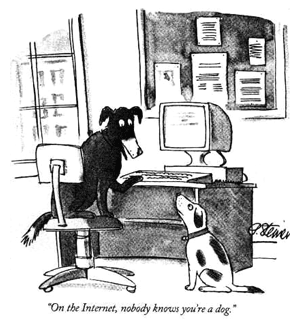
Outside the world of MOOs, the pervasive anonymity of the web means that identity-play can feature in all kinds of online environments. Individuals commonly assume new personas on blogs or personal homepages. Similarly, while chat rooms and Instant Messagers may not provide the range of gender identities found in LambdaMOO, and may not leave race an "unmarked category," they still offer innumerable opportunities for adopting identities independent of the identities expressed by users' physical bodies. In fact, chat rooms are notorious for the fluidity of their inhabitants' identities, as suggested by the frequent warnings about meeting chat room buddies in RL. After all, "On the Internet, nobody knows you're a dog." (24)
For queers, trans individuals, and others seeking identity innovation in RL, the fluidity of identity online is particularly welcome. For much of the Internet user base, the suspension of disbelief required for meaningful immersion in online worlds such as LambdaMOO can be powerful, but may not enable some to comfortably imagine spivak, neuter, or splat identity. But as Bell writes, "transgendered people already know all about 'consensual hallucination' through their RL identities, and have an 'in-built' expertise that makes them especially at home in cyberspace." With such valuable talents, trans and queer individuals may find online "gender-play [to be] personally and politically productive—as enabling new bodies, identities, and communities that extend beyond cyberspace." (25)
Bell recounts the love story of Jel, the female persona of a heterosexual man in RL, and Plastique, in RL a lesbian, playing "a virtual version of herself," who had a love affair in LambdaMOO. Shortly after ending their online affair, "Plastique entered into a relationship [in LambdaMOO] with a male persona." The same heterosexual man behind Jel, it turned out, played this persona as well. Meanwhile, Jel assumed that Plastique, "the 'virtual woman' he was seducing'" was a man in RL. (26) Through this complicated web of identities, the man behind both Jel and Plastique's subsequent male online lover was able to experience what he thought was a sort of gay homosexual relationship through the veneer of straight and lesbian cyberaffairs. The woman behind Plastique, meanwhile, got to experience cybersex with two different partial identities of the same person, and was able to explore heterosexual and lesbian homosexual cyberaffairs in a safe environment. As in this story, for some, the Internet "offers a safe place to experiment with gender, sex, and sexuality." (27) Such nuanced explorations of identity and sexuality would be difficult to perform in RL without serious consequences. For those who are able to surpass the economic, educational, cultural, racial, and temporal barriers that surround the Internet, the online environments that enable such interaction are valuable assets to individuals interested in such explorations.
Online Hyper-Performance and RL Script Enactment
While the anonymity of the internet facilitates an important process of identity exploration for some, Steven McLain offers the reminder that "the anonymity of the internet can work both ways." Speaking specifically about racial identity online, he notes that it is true that "no one can see what color I am, but no one has to see what color I am. Therefore, the touchy subject of race can be brushed under the mousepad." (28) While the requirement to choose a racial identifier in MOOScape makes that space an exception, for most of the Internet, the freedom to identify racially however one chooses, or not at all, leads to a whitewashing of the web, where whiteness is "an unmarked category." In many online spaces, "users only elect to signify race if they want to fetishize it in their new online identities." (29) Lisa Nakamura, discussing assumptions of Asian identity in LambdaMOO "depressingly concludes that Asianness is both domesticated and erased there." (30) Far from proving liberatory with respect to race, the anonymity of the Internet serves to reinforce the normalization of whiteness and, in the absence of bodily signifiers of racial identity, places an onus on users to announce their race if they wish to be recognized as anything other than white.
Often, when users participate in identity-play by announcing racial signifiers, their engagement in "'racial passing:' playing the 'fantasy other' … like virtual cross-dressing, reaffirms stereotypes in a location where we might expect the proliferation of new identity formations instead." (31) This sort of thrill seeking through "identity tourism" seems prevalent online. Marginalized identities, racial, and otherwise, are often fetishized in cyberspace, reinforcing RL marginalization. For example, Asian identities are often sexualized and fetishized online, as discussed by Daniel Tsang in his discussion of "queer 'n' Asian virtual sex." (32)
Related to fetishization, identity expression online often involves a sort of hyper-performance that amplifies RL stereotypes. Bell writes that "the medium of MUDding makes all participants 'drag up'—and that this in itself leads to stereotypical gender performances, since 'passing' calls for being believable, and being believable is easier the more stereotypical and 'conventional' the performance is." (33) Such stereotyping through identity performance occurs even when users are performing personas that at first glance would seem to undermine traditional gender representations. Bell discusses a class of MUDs, known as FurryMUDs or FurryMUCKs, in which participants take on the personas of anthropomorphized animals. On such MUDs, Bell recounts the observation of "similarly problematic 'hypergendering.'" Such hyper-performance may emerge especially in environments like FurryMUDs where the identities expressed are nominally distant from pervasive RL identities. In such cases, users drawn to interact with each other in socially familiar ways find gender hyper-performance necessary to align their unconventional identities with their conventional frameworks for interacting.
In more conventional web worlds, of the sort more reminiscent of the Tom Hanks and Meg Ryan movie "You've Got Mail," interactions tend even further towards conventional representations of identity. AOL teen chat rooms are hotbeds of conventional gender and relationship performance, with frequent calls of "A/S/L," (a request for chatters to respond with their Age/Sex/Location) to divide users into relevant camps followed by invitations to enact stereotypical hetero gender relations in private or public chats. In an analysis of Internet relay chat rooms (IRC), Slater remarked that "many of the sexual interactions online are 'hyperconventional,' fail to 'produce new sexual configurations,' and are 'more consumerist than deconstructive.'" (34)
When individuals do engage in non-conventional identity-play online, they are often ridiculed or discouraged from doing so. Ann Kaloski "cruised [LambdaMOO's] 'sex rooms' as a tall, down-covered spivak. After getting very little by the way of action, Kaloski received a telling message: 'If you want sex, change your gender to female.'" (35) Rather than reward Kaloski's persona's gender non-conformity, the overwhelming majority of LambdaMOOers weren't interested in playing along, leaving her with no options for meaningful identity exploration. In fact, "even in MUDs," online worlds that often appear institutionally supportive of gender play, "gender-switching is only practiced by a small number of participants, and is viewed by many players as 'dishonest.'" (36) This is striking, considering that MUDs have their origin in fantasy or role-playing games (RPGs) such as Dungeons and Dragons. In the non-RPG-inspired web, identity-play, or masquerading as another gender is viewed even more negatively: "In other online contexts, where 'fantasy' is not foregrounded, virtual cross-dressing has been seen to be even more problematic." (37)
In often text-only online worlds, gender hyper-performance can additionally take the form of enactment of RL scripts. An often-cited example of this is the case of "virtual rape" in LambdaMOO described in the Village Voice by Julian Dibbell. Dibbell reports
The recognition, by exu, Moondreamer, and many LambdaMOOers, that the occurrence described above constituted "virtual rape" displays the power of the "consensual hallucination" that makes such spaces salient. "Virtual rape" extends what can constitute rape to the realm of illocutionary speech acts, beyond acts in the physical world, or raises the question of whether "physical acts" can take place in the online world of LambdaMOO. Supposing that the answer is "no," or at least, that such "physical acts" do not impede upon RL bodies, "virtual rape" can be seen as shifting "the focus from the anatomy of women's bodies to the construction of individuals' minds." (39) As Simca Horwitz writes,That he commenced his assault entirely unprovoked, at or about 10 p.m. Pacific Standard Time. That he began by using his voodoo doll to force one of the room's occupants to sexually service him in a variety of more or less conventional ways. That this victim was exu, a Haitian trickster spirit of indeterminate gender, brown-skinned and wearing an expensive pearl gray suit, top hat, and dark glasses. That exu heaped vicious imprecations on him all the while and that he was soon ejected bodily from the room. That he hid himself away then in his private chambers somewhere on the mansion grounds and continued the attacks without interruption, since the voodoo doll worked just as well at a distance as in proximity. That he turned his attentions now to Moondreamer, a rather pointedly nondescript female character, tall, stout, and brown-haired, forcing her into unwanted liaisons with other individuals present in the room, among them exu, Kropotkin (the well-known radical), and Snugberry (the squirrel). That his actions grew progressively violent. That he made exu eat his/her own pubic hair. That he caused Moondreamer to violate herself with a piece of kitchen cutlery. That his distant laughter echoed evilly in the living room with every successive outrage. That he could not be stopped until at last someone summoned Iggy, a wise and trusted old-timer who brought with him a gun of near wizardly powers, a gun that didn't kill but enveloped its targets in a cage impermeable even to a voodoo doll's powers. That Iggy fired this gun at Mr. Bungle, thwarting the doll at last and silencing the evil, distant laughter. (38)
When individuals in LambdaMOO conceptualize Mr. Bungle's actions as rape, they are understanding his actions as the enactment of a script. Because there is no bodily contact, the scripted nature of his actions is further emphasized. Mr. Bungle does not need to physically overpower his targets, in fact there is no way for him to do this. Rather, he is successful because he deploys conventional tropes of sexual assault. (40)
The power of such "conventional tropes" both in LambdaMOO and in the real lives of the people behind exu and Moondreamer (41) reveals that the rape script and, as we have seen, a whole range of conventional gendered scripts and identities remain salient online. All across the Internet, even in the most radically de-centered environment for gender identity-play, stereotypical RL identities and relationships are predominant and are reinforced.
Identity-play in RL
One of the key promises of identity-play online was that the radical reconfigurations of race, gender, and sexuality that might occur in cyberspace would assist in queering identity in RL. While individuals do find that their experiences with online identity-play impinge upon the rest of their lives, this impinging often has the effect of reinforcing conventional notions of identity.
When players shed their anonymity to reveal gender norm transgressions online, the revelations often reverberate in RL. Bell notes how through hyper-performing gender, "gender identities become more rigidly defined, and RL genders most rigidly of all, as evidenced by examples Kendall cites of players feeling 'betrayed' when the RL gender of another participant is revealed as different from their MUD desc." (42) Lori Kendall reprints one MUDder's comments:
For this MUDder, online gender-norm transgressions have had the effect of rigidifying the MUDder's negative impression of gender play. Far from queering RL identity, the transgression has only entrenched the MUDder's straightness. RL norm-reinforcing consequences also attend another example of online gender-identity assumption. In the case of the "cross-dressing psychiatrist,"Back when I viewed MUDS as a REAL reality, I fell in love with a female character. … But anyways turned out 'she' was a he. Since then my personal policy is to NEVER get involved with anyone on a mud in a deep personal way. (43)
As in the previously discussed case, the revelation of the psychiatrist's "cross-dressing" led to a RL feeling of betrayal. The psychiatrist's masquerade, in this case, seems particularly insensitive, and it is easy to see why such a feeling of betrayal might have arisen. The psychiatrist's mistake is worth investigating, however, and annunciates the difficulty of navigating issues of deception and identity-play.… a male psychiatrist masqueraded on-line as a disabled woman, and built up a close circle of online friends. When his conscience got the better of him, he decided to 'kill off' his online persona, 'Julie,' and then came clean about the whole incident. Those who had befriended 'Julie' felt bitterly betrayed by the deception. (44)
Likewise, in instances where identity boundary transgressions are never revealed, those transgressions can still reinforce identity-normative behavior in RL. Nina Wakeford cites the common chat room scenario in which "men pretend to be women to attract the attention of 'real' women, who are in fact themselves other men pretending to be women." (45) The subtle (or not so subtle) gay homosexuality that underlies these simultaneous heterosexual fantasies of ostensibly lesbian interaction fails to manifest itself. Indeed, "the practice of such cross-dressing does nothing to unsettle the assumption and practice of cyberspace as a process of heterosexuality." (46) Instead, both men unknowingly collude in the satisfaction of their mutual fantasy.
Just as transgressive acts of identity-play tend to support rather than undermine RL identity norms, acting out gender normative scripts in cyberspace can also reinforce those norms. Writing about the Mr. Bungle "virtual rape" case, Horwitz argues that "the notion of virtual rape is mediating how we conceptualize non-technologized rape." (47) Through its success in transporting the "conventional tropes of sexual assault" to cyberspace, the salience of "virtual rape" is antithetical to the work done by antirape feminist theorists to resist the omnipresence of the rape script. In addition to unleashing tremors throughout LambdaMOO, the Mr. Bungle case powerfully impacted RL. By "shifting the focus from … women's bodies to the construction of individuals' minds," (48 and thus reinforcing the rape script, the salience of such an enactment in cyberspace is counterproductive to the goal of rape prevention. As Sharon Marcus writes, "to make [verbal acts] metaphors for rape itself … occludes the gap between the threat and the rape—the gap in which women can try to intervene, overpower, and deflect the threatened action." (49) Far from queering identity in RL, identity expression online, whether in the form of script enactment, transgressive gender play, or racial innovation, leaves hierarchies more entrenched and identity more rigidly constructed. While cyberspace offers a much-needed sanctuary to certain marginalized populations, for most, the Internet does not fulfill its liberatory promise.
- Steiner, Peter. 1993. New Yorker, July 5, 1993 issue (Vol. 69 (LXIX) no. 20). page 61.
- Kittler, Friedrich A. 1999. Gramophone, Film, Typewriter, trans. Geoffrey Winthrop-Young and Michael Wutz. Stanford, CA: Stanford University Press. Page 184.
- Ibid, page 182.
- Ibid, page 183.
- Ibid, page 195.
- Ibid.
- Ibid, page 208.
- Ibid, page 209.
- Ibid, page 208, and Max Weber, quoted in Ibid, page 213.
- Ibid, page 210.
- Ibid, page 194.
- Ibid, page 182.
- Ibid, pages 208-209.
- Ibid, page 214.
- Gamson, Joshua. 2003. "Gay Media Inc.," in Cyberactivism: Online Activism in Theory and Practice, ed. Martha McCaughey and Michael D. Ayers. New York and London: Routledge, 255-278. Page 258 and Gauntlett, David, ed. 2000. Web.studies: Rewiring Media Studies for the Digital Age. New York: Oxford University Press, quoted in Ibid.
- "A MUD (Multi-User Dungeon or, sometimes, Multi-User Dimension) is a network-accessible, multi-participant, user-extensible virtual reality whose user interface is entirely textual. Participants (usually called players) have the appearance of being situated in an artificially constructed place that also contains those other players who are connected at the same time. Players can communicate easily with each other in real time. This virtual gathering place has many of the social attributes of other places, and many of the usual social mechanisms operate there. Certain attributes of this virtual place, however, tend to have significant effects on social phenomena, leading to new mechanisms and modes of behavior not usually seen IRL (in real life)." —Curtis, Pavel. 1992. "Seminar on People, Computers, and Design." Stanford University, January 8, 1992.
- Bell, David. 2001. An Introduction to Cybercultures. London and New York: Routledge. Page 150.
- Haraway, Donna. 1995. "Cyborgs and Symbionts: Living Together in the New World Order," in The Cyborg Handbook, ed. C. Gray. London: Routledge. Page 295.
- Ibid.
- Bell, pages 124-125.
- Ibid.
- Ibid, page 120.
- Ibid.
- Steiner, page 61.
- Bell, page 126.
- Ibid.
- Ibid.
- McLaine, Steven. 2003. "Ethnic Online Communities: Between Profit and Purpose," in Cyberactivism: Online Activism in Theory and Practice, ed. Martha McCaughey and Michael D. Ayers. New York and London: Routledge, 233-254. Page 235.
- Bell, page 120.
- Ibid.
- Ibid.
- Tsang, David. 2000. "Notes on Queer 'n' Asian Virtual Sex," in The Cybercultures Reader, ed. David Bell, B. Kennedy. London: Routledge, 432-438.
- Bell, page 125.
- Slater. 1998. "Trading Sexpics on IRC: Embodiment and Authenticity on the Internet," in Body and Society, 4: 91-117, pages 99-100. Quoted in Bell, page 127.
- Bell, page 125.
- Ibid.
- Ibid, pages 125-126.
- Dibbell, Julian. 1993. "A Rape in Cyberspace," in Village Voice, 21, December 1993.
- Horwitz, Simca Lena. 2003. "Virtual Rape, Illocutionary Speech, and the Rape Script," unpublished. Page 12.
- Ibid.
- Ibid.
- Bell, page 125.
- Kendall, Lori. 1996. "MUDder? I hardly know 'er! Adventures of a Feminist Woman MUDder," in Wired Women: Gender and New Realities in Cyberspace, ed. L Cherney and E. Reba Weise. Seattle: Seal Press. Page 218.
- Stone, Allucquere Roseanne. 1995. The War of Desire and Technology at the Close of the Mechanical Age. Cambridge, MA: MIT Press, cited in Bell, page 126.
- Wakeford, Nina. 1996. "Sexualized Bodies in Cyberspace," in Beyond the Book: Theory, Culture, and the Politics of Cyberspace, ed. W. Chernaik, M. Deegan, and A. Gibson. London: London University Press. Page 99.
- Ibid.
- Horwitz, page 13.
- Ibid, page 12.
- Marcus, Sharon. 1992. "Fighting Bodies, Fighting Words: A Theory and Politics of Rape Prevention," in Feminists Theorize the Political, ed. Judith Butler and Joan W. Scott. New York: Routledge, 385-403. Page 389.